
Understanding Photography Lenses: Aperture, Zooms, and What Each Lens Is Optimized For
Choosing the right photography lenses is one of the most important decisions a photographer can make. While camera bodies evolve quickly, lenses tend to stay with us for many years—and they have a far greater impact on image quality, creative control, and shooting style.
This article breaks down photography lenses in a practical, easy-to-understand way. We’ll explore:
- The difference between fixed (constant) aperture and variable aperture lenses
- Zoom lenses and their advantages and disadvantages
- Minimum f-stops and what they mean for real-world photography
- What different lenses—both zooms and primes—are truly optimized for
Whether you’re a beginner or an intermediate photographer refining your gear choices, this guide will help you make smarter lens decisions.
1. The Basics: What a Lens Really Does
A lens controls three critical aspects of an image:
- Field of view – How wide or narrow the scene appears
- Light transmission – How much light reaches the camera sensor
- Optical rendering – Sharpness, contrast, distortion, and background blur
Three of the most important characteristics of any lens are:
- Focal length (measured in millimeters)
- Maximum aperture (measured in f-stops)
- Minumum Focusing Distance (measured in feet or meters)
Understanding how these interact is the key to understanding lenses as a whole.
2. Fixed (Constant) Aperture vs Variable Aperture Lenses
One of the most common points of confusion for photographers is aperture behavior in zoom lenses.
Fixed (Constant) Aperture Lenses
A fixed aperture lens maintains the same maximum aperture throughout the entire zoom range.
Example:
- 24–70mm f/2.8
- 70–200mm f/2.8
No matter what focal length you zoom to, the widest aperture remains the same.
Advantages of Fixed Aperture Lenses
- Consistent exposure while zooming
- Better low-light performance
- Shallower depth of field across the entire zoom range
- Professional-level optical quality
- Ideal for manual shooting and video work
Disadvantages of Fixed Aperture Lenses
- Larger and heavier
- More expensive
- Require more robust lens construction
Who They’re For
Fixed aperture lenses are designed for:
- Professional photographers
- Event, wedding, and sports shooters
- Videographers
- Anyone who needs consistent performance in changing lighting conditions
Variable Aperture Lenses
A variable aperture lens changes its maximum aperture as you zoom.
Example:
- 18–55mm f/3.5–5.6
- 70–300mm f/4–5.6
As you zoom in, the maximum aperture becomes smaller (lets in less light).
Advantages of Variable Aperture Lenses
- Smaller and lighter
- More affordable
- Excellent for travel and casual photography
- Energy-efficient for everyday use
Disadvantages of Variable Aperture Lenses
- Exposure changes while zooming
- Reduced low-light capability at longer focal lengths
- Less background blur at telephoto settings
- Not ideal for consistent manual exposure or video
Who They’re For
Variable aperture lenses are optimized for:
- Beginners
- Hobbyists
- Travel photographers
- Everyday, well-lit shooting environments
3. Zoom Lenses: Flexibility vs Specialization
Zoom lenses cover a range of focal lengths, allowing photographers to reframe without changing lenses.
Common Zoom Categories
- Wide-angle zooms: 10–24mm, 16–35mm
- Standard zooms: 24–70mm, 18–55mm
- Telephoto zooms: 70–200mm, 100–400mm
Pros of Zoom Lenses
- Extreme versatility
- Fewer lens changes
- Faster reaction to changing scenes
- Ideal for unpredictable environments
Cons of Zoom Lenses
- Typically heavier than primes
- More complex optical design
- Often less sharp than primes (especially at extremes)
- Smaller maximum apertures compared to primes
Zoom lenses are about convenience and adaptability, not specialization.
4. Minimum f-Stops Explained
The minimum f-stop (often called the maximum aperture) tells you how wide the lens can open.
Why f-Stops Matter
A wider aperture:
- Lets in more light
- Allows faster shutter speeds
- Creates shallower depth of field
- Produces stronger background blur (bokeh)
Common Maximum Apertures and Their Uses
f/1.2 – f/1.4
- Extremely shallow depth of field
- Exceptional low-light performance
- Artistic subject isolation
Optimized for:
- Portraits
- Fine art
- Low-light environments
f/1.8 – f/2
- Excellent balance of light and sharpness
- More affordable than ultra-fast lenses
Optimized for:
- Portraits
- Street photography
- Everyday low-light shooting
f/2.8 (Professional Standard) Maximum F-Stop to be considered a fast lens!
- Gold standard for professional zooms
- Strong subject separation
- Consistent performance
Optimized for:
- Weddings
- Events
- Sports
- Commercial work
f/4
- Lightweight professional option
- Excellent sharpness
- Less background blur than f/2.8
Optimized for:
- Landscape photography
- Travel
- Daylight shooting
f/5.6 and Smaller
- Compact and affordable
- Requires good lighting
Optimized for:
- Outdoor photography
- Casual shooting
- Wildlife in daylight
5. What Different Lenses Are Optimized For (Individual Lens Breakdown)
Instead of grouping lenses by type, it’s often more useful to understand what specific lenses are optimized for. Below is an individual, real-world breakdown of common focal lengths and aperture combinations.Below is the revised professional list of intermediate and professional lenses, now including the 100–300 mm f/2.8 zoom. Each entry remains standalone with clear specifications, typical use, pros, and cons. The list remains manufacturer-neutral.
Zoom Photogeraphy Lenses
Prime Photography Lenses
Specialty Photography Lenses
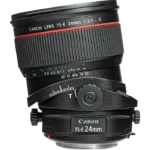
24mm F-3.5 Tilt-Shift
$2200
No optical stabilization typical, no high speed internal AF motor
Use: Perspective control for architecture, interiors, product photography, and selective focus effects.
Pros: Corrects converging verticals without digital correction.
Precise control over plane of focus.
High optical quality.
Cons: Manual focus and slower workflow.
Expensive and highly specialized.
Notes on Terminology
Aperture: Lower numbers (f/1.2–f/2.8) indicate greater light gathering and stronger depth-of-field control. Constant aperture lenses maintain the same maximum aperture throughout the zoom range; variable aperture lenses do not.
Image Stabilization/Vibration Reduction: Professional lenses often include optical stabilization, particularly telephoto zooms and long primes. Some camera systems rely on in-body stabilization (sensor shift) in addition to or instead of lens stabilization.
Internal AF Motor: At intermediate and professional levels, autofocus systems are fast and quiet, typically via linear, stepping, ultrasonic, or other high-performance drive motors.
6. Choosing the Right Lens for Your Photography
Ask yourself:
- Do I value flexibility or image quality more?
- Do I often shoot in low light?
- Do I need fast autofocus and consistency?
- Am I shooting controlled scenes or unpredictable moments?
There is no “best” lens—only the best lens for your shooting style.
Final Thoughts
Understanding photography lenses is about understanding trade-offs:
- Fixed vs variable aperture
- Zoom vs prime
- Speed vs portability
- Cost vs performance
Once you understand what each lens is optimized for, gear decisions become far easier—and your photography becomes more intentional.
A great lens doesn’t just capture light. To learn about the exposure triangle check out these videos.
It shapes how you see the world.