- Photography Filters for Color and Black-and-White Film
- Why filter quality matters
- Which filter brand is best?
- Screw-on filters versus adapter-and-holder systems
- Understanding filter factors and exposure compensation
- Filters for color photography
- Filters for Color Film Photography
- Filters for black-and-white photography
- Filters for Black-and-White Photography
- Filters for Black-and-White Photography
- Choosing and using your filter kit
- Frequently asked questions
- Sources
SHUTTER BUG ACADEMY / LEARN FILM PHOTOGRAPHY
By John Whitehead
A filter changes the light before it reaches the film or sensor. In color photography, that can mean correcting a color cast, controlling reflections or reducing exposure. In black-and-white photography, colored filters change how subject colors become shades of gray. Choosing the filter is a creative decision; compensating for the light it absorbs is an exposure decision.
Why filter quality matters
Why good lenses deserve good filters
A filter becomes part of the optical path. Poor flatness, uneven glass, unwanted tint, surface contamination and reflections can compromise a good lens. The damage may appear as flare and reduced local contrast rather than obvious softness. Bright windows, the sun near the frame and night lights are useful stress tests. An expensive lens cannot undo stray light introduced by a poor filter.
What multi-coating actually does
Every air-to-glass surface reflects some light. Thin anti-reflection layers use optical interference to reduce those reflections. A multi-layer design works over a broader range of wavelengths than a simple coating, helping preserve contrast and suppress ghosts. B+W calls its system MRC, or Multi Resistant Coating; MRC nano also emphasizes easy cleaning. Water- and oil-repellent top layers are useful, but they are not the same function as anti-reflection layers. [3]
Coatings do not cancel filter factors
A coated red filter still needs to absorb selected wavelengths, and a coated ND still reduces exposure. High transmission claims describe the relevant passband or coating performance, not a promise that every filter passes almost all incoming light. More advertised layers do not, by themselves, prove better performance. Judge optical quality, neutrality where intended, durability and flare resistance.
Does every lens need a protective filter?
A quality clear or UV filter is useful around salt spray, dust or blowing sand. In clean conditions, using only a lens hood is also reasonable. Even excellent filters can produce ghosts around strong point light sources. Remove the protective filter before adding an effect filter when practical, and avoid unnecessary stacking.
Which filter brand is best?
My preference is B+W for premium screw-on filters. I value a well-made mount and effective coatings, but I would not call any brand the best for every job. For adjustable graduated filters, a well-designed holder system may matter more than the name on a round filter. The following are useful manufacturers to compare, not a laboratory ranking.
| Manufacturer | Best fit to consider | What to know |
|---|---|---|
| B+W / Schneider-Kreuznach | My preferred premium screw-on choice | Excellent choice when you value durable brass mounts and high-quality coatings. Select the exact model and coating; older used filters may be uncoated or single-coated. Current monochrome names include Y475, O550 and R610. |
| Hoya | Broad screw-on selection | Offers multiple product tiers and color-correction options. Compare the actual coating and mount specification rather than assuming all Hoya filters are equivalent. |
| Tiffen | Traditional color and creative filters | A useful source for numbered color-conversion filters, monochrome contrast filters and diffusion. Product-specific factors make identification especially important. |
| LEE Filters | Graduated and modular systems | A strong option for photographers who need to slide a graduated filter to match the horizon. Offers adapters, holders and different filter materials. |
| NiSi | Modern landscape systems | Worth considering for a coordinated holder, polarizer and ND setup. Match the holder to the lens and required filter size. |
| Cokin | Creative holder systems | Offers adapter-based systems and both resin and glass ranges. Its different ranges should not be treated as one uniform optical specification. |
Screw-on filters versus adapter-and-holder systems
Screw-on filters
A round filter threads directly onto the lens. Match the diameter marked with the diameter symbol, such as 52 mm or 77 mm; this is not the lens focal length. Screw-on filters are compact and convenient for handheld work. Their drawbacks are repeated threading, possible binding and the cost of different sizes. Note: Good filter brands will sell slim screw in filters for wide angle lenses.
Step-up rings
A 52-to-77 mm step-up ring lets a 52 mm lens use a 77 mm filter. Buying for your largest commonly used thread can save money. Check hood and cap fit. Step-down rings place a smaller filter in front of a larger lens and can vignette. Even step-up arrangements need a corner check on very wide lenses.
Adapter ring + holder + slide-in filter
The adapter attaches to the lens, the holder attaches to the adapter, and square or rectangular filters slide into slots. A graduated filter can move vertically and rotate with the holder. One set can serve several lenses through different adapters. The tradeoffs are bulk, handling, exposed surfaces and possible light leaks during long exposures.
Glass, resin and compatibility
Good optical resin can perform well and is light, but scratches more easily. Glass can be durable at the surface yet break when dropped. Neither material name guarantees quality. Check width, thickness, slot fit, light seals and wide-angle coverage. A magnetic round system speeds changes but does not provide the positioning freedom of a rectangular grad.
Understanding filter factors and exposure compensation
Read factors correctly
A 2x factor means twice the exposure, or +1 stop. A 4x factor is +2 stops; 8x is +3; 16x is +4. Stops = log2(factor). Factors multiply when stacking ordinary filters, while their stop losses add. With strong colored filters, overlapping transmission bands can make the simple product only an approximation.
With an incident or separate meter
Meter without the filter, then add the stated compensation. At 1/125 second and f/8, a 4x filter calls for approximately 1/30 at f/8, or 1/125 at f/4. Keep the film speed unchanged, or deliberately lower the meter ISO by the factor; do not do both. ISO 400 divided by 4 gives a meter setting of ISO 100.
With through-the-lens metering
A TTL meter sees the filtered light and often compensates automatically. Do not blindly add the full filter factor again. Strong red, orange or blue filters can mismatch a meter’s spectral response. Test your camera and film, or use an unfiltered incident reading plus the maker’s factor. Bracket important work.
Why factors vary
Colored-filter factors depend on the filter’s spectral transmission, film sensitivity and light source. A red filter may cost more light under a blue-rich sky than under warm illumination. Numbers in this guide are typical starts or explicitly identified product examples, not universal values for every filter of that color.
| Factor | Extra exposure | From 1/125 second |
|---|---|---|
| 2x | +1 stop | About 1/60 |
| 4x | +2 stops | About 1/30 |
| 8x | +3 stops | About 1/15 |
| 16x | +4 stops | About 1/8 |
Apply a factor once. A TTL reading may already include the filter loss; an incident reading does not. Film reciprocity correction, when required, is an additional step.
Filters for color photography
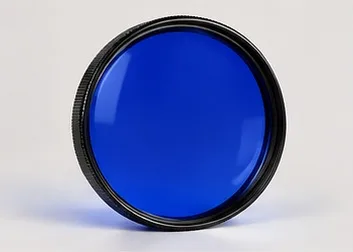
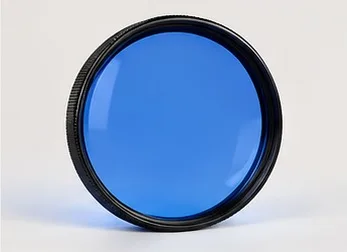
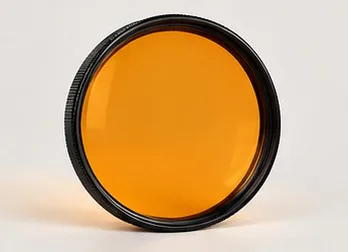
Film has a fixed nominal color balance. Daylight film is commonly balanced near 5500 K; tungsten film is often balanced near 3200 K. A blue conversion filter helps daylight film under tungsten light, while an amber conversion filter helps tungsten film in daylight. Filtration removes selected light; it cannot supply missing wavelengths. Extra exposure by itself does not correct a color cast.
Color negative film often allows substantial correction during scanning or printing, but filtration can improve the balance recorded in the negative. Slide film offers much less room for later correction. In mixed daylight and tungsten, one lens filter changes both sources: choose the dominant light, accept a creative difference, or correct the lights themselves. LEDs and fluorescent lamps may have uneven spectra that Kelvin alone cannot describe.
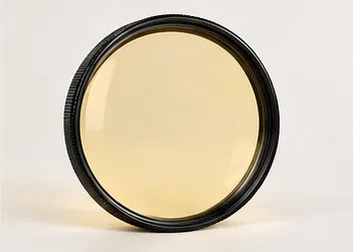
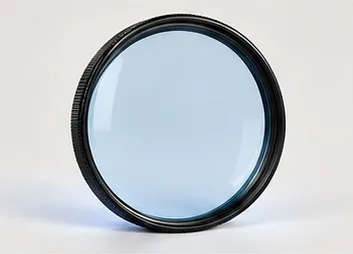
Full conversion filters such as 80A and 85B address large daylight/tungsten differences. Balancing filters such as 81A and 82A make smaller shifts. A filter does not change the physical lamp temperature; it changes the spectral balance of the light reaching the film. Use mired values for precise matching rather than treating a filter as a constant Kelvin adjustment.
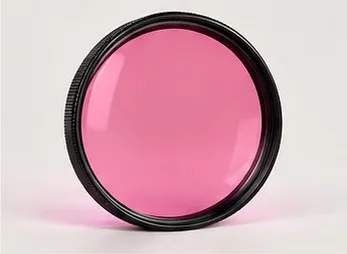
Other color-correction filters
81B and 81C provide stronger warming than 81A; 82B and 82C provide stronger cooling than 82A. The amber 85 family includes strengths intended for different film balances. Skylight 1A/1B filters provide a very mild warming/UV effect, usually with negligible exposure loss. Color-compensating filters come in cyan, magenta, yellow, red, green and blue at multiple densities. Use their exact specifications: neither a CC color nor a filter family has one universal factor.
Filters for black-and-white photography
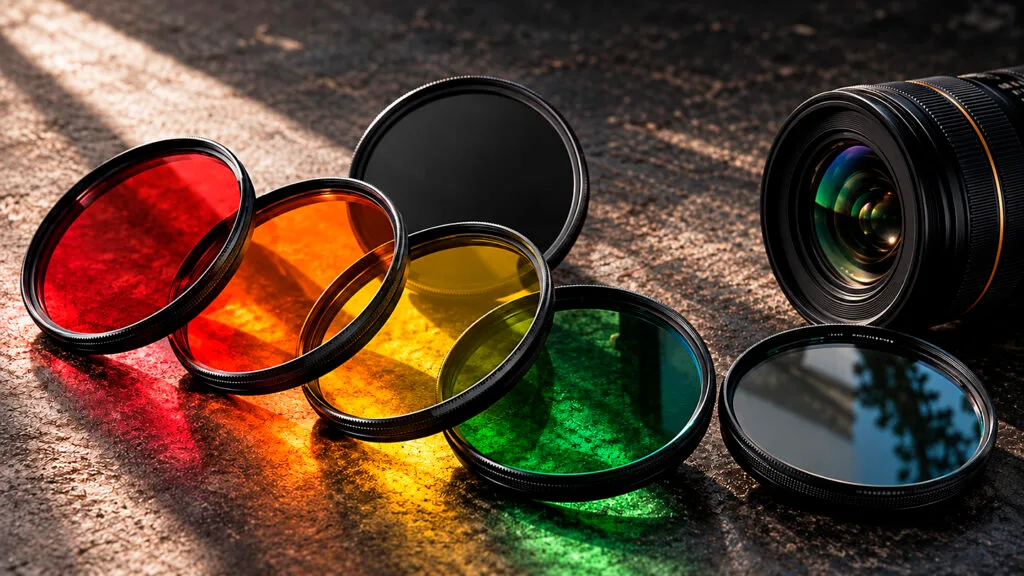
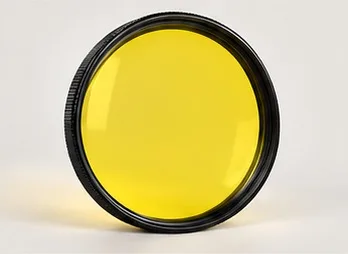
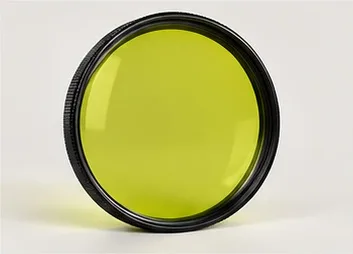
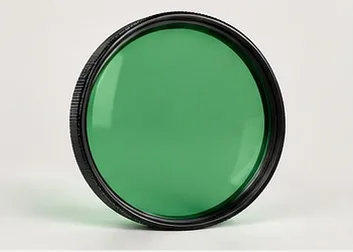
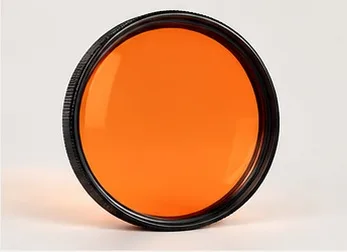
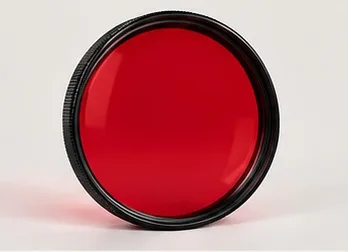
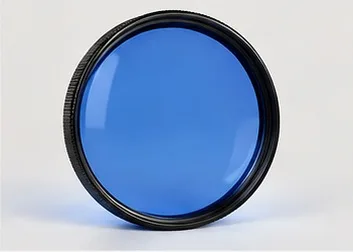
On panchromatic black-and-white film, a filter generally makes its own color relatively lighter and opposing colors relatively darker in the final positive image. It changes tonal separation, not the development contrast of the entire negative. A red flower and green leaf that originally print as similar gray can separate dramatically when you choose which wavelengths to transmit.
These rules assume film sensitive across the visible spectrum. Orthochromatic film is not red-sensitive: a strong red filter can block nearly all usable light. For infrared effects, pair an appropriate IR filter with a compatible film or converted camera; there is no universal IR factor. Ordinary black-and-white film does not become infrared film when a dark red filter is attached.
Think of filters as selective tonal controls. They can separate two colors that would otherwise print as similar gray, but they can also make different colors merge. They do not replace thoughtful exposure, development or printing.
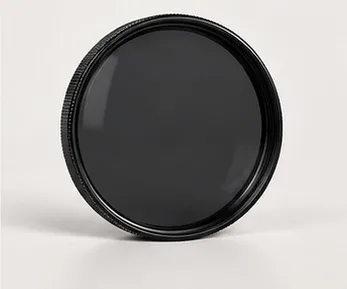
Reading ND labels
| Optical density | Factor | Stops |
|---|---|---|
| 0.3 | 2x | 1 |
| 0.6 | 4x | 2 |
| 0.9 | 8x | 3 |
| 1.8 | 64x | 6 |
| 3.0 | About 1000x | About 10 |
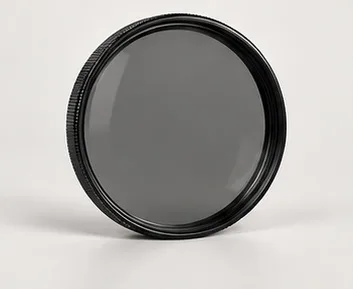
Variable ND filters have a range of attenuation and can show unevenness or an X pattern near their maximum setting. Diffusion, mist and star filters control highlight rendering; their strength numbers are not exposure factors. Infrared-pass filters require compatible film or a suitable camera and dedicated exposure testing.
Choosing and using your filter kit
Build a small kit
For black-and-white film, start with yellow, then add orange or red for stronger sky separation and green for foliage. For color film, buy correction filters for the film and lighting you actually use. A CPL and a suitable ND are useful across both. My premium screw-on preference is B+W; my holder choice would depend on lenses, grad positioning and system compatibility.
Make a useful filter test
Choose a scene with blue sky, clouds, red and green subjects, and stable illumination. Make an unfiltered reference, then expose each filtered frame with its correct compensation. Record film, light, filter code, meter method and settings. Keep development and scan settings consistent; automatic scan corrections can hide the differences.
Clean and store carefully
Blow off grit before wiping. Use a clean lens cloth and an appropriate cleaning fluid, following the maker’s instructions. Hold filters by their edges, avoid overtightening and store them separately. Check used filters for haze, scratches, separation and damaged threads.
For digital black-and-white
On a standard color digital camera, capture RAW in color and use a black-and-white mixer for flexible tonal control. Physical colored filters throw away light and channel information. A dedicated monochrome sensor is a different case: physical filters are a key tonal-control tool. Polarizers, ND and grads remain useful optical tools with digital capture.
Frequently asked questions
Will a cheap filter always ruin a photograph?
No. Differences may be subtle in easy light. The risk becomes more visible in backlight, point-source lighting and demanding optical conditions. Test the actual filter with your lens rather than relying only on its price.
Can I leave a yellow filter on my black-and-white camera?
You can, if its effect suits your work and you consistently account for exposure. It still costs light and may not suit every subject. Remove it when you need the unfiltered tonal response or the fastest possible shutter speed.
Can I use black-and-white contrast filters on color film?
Yes, for deliberate color effects, but a strong yellow, red or green filter creates a pronounced cast. It is not a substitute for the appropriate pale balancing or conversion filter.
Should I stack filters?
Only when the combination serves a clear purpose. Additional surfaces can increase flare, and thick stacks can darken corners. Remove an unnecessary protective filter first. Check exposure and the frame edges after combining filters.
Sources
Manufacturer guidance checked September 29, 2026. Approximate values are identified as such; use the exact product and film instructions for critical work.
- ILFORD: Using colour filters for black and white photography
- B+W: Current black-and-white filters
- B+W: Coating systems
- LEE: LEE100 system
- Cokin: Filter ranges and adapter systems
- Tiffen: 80A conversion
- Tiffen: 80B conversion
- Tiffen: 85B conversion
- Tiffen: 81A balancing
- Tiffen: 82A balancing
- Tiffen: Film enhancement guide
- Tiffen: Green #11
- Tiffen: Red #25
- B+W: Clear and UV filters
- Hoya: Color correction range
- NiSi: Choosing a filter system