By John Whitehead | Shutter Bug Academy
- What Is the Best Manual Film Camera? A Practical Guide to Cameras, Lenses, and Buying Used
- The short answer: choose a system, then choose a body
- What does “manual film camera” actually mean?
- Why the lens matters more than the badge
- Nikon: an excellent mechanical system
- Canon: excellent FD lenses and a choice of camera styles
- Minolta: a rewarding place to look for value
- Pentax: simplicity, with an overlooked compact alternative
- Olympus: a small mechanical SLR worth including
- Leica M: a premium choice for a particular way of seeing
- Exposure matters – especially when you want usable shadow detail
- Where to buy a used film camera
- What to inspect before buying a body
- What to inspect before buying a lens
- How much should you spend?
- My practical recommendation
- Honorable Mentions: Other Film Cameras Worth Considering
- Nikkormat FT3: A Solid Alternative to the Nikon FM
- Canon F-1: A Professional Mechanical Workhorse
- Honeywell Pentax Spotmatic: A Classic Route into Takumar Lenses
- Yashica FX-3 Super 2000: A Straightforward Mechanical Alternative
- Minolta X-570: An Electronic Camera with Useful Manual Control
- Canon A-1: More Exposure Options in the FD System
- Nikon FM3A: Mechanical Operation with Aperture-Priority Convenience
- Sources and further reading
A good manual film camera makes the relationship between light, aperture, shutter speed, and focus feel wonderfully direct. Turn a ring. Set a dial. Look carefully. Make a photograph. There is no screen to check and no reason to let a menu interrupt the moment.
But which camera should you buy? The Nikon FM2n is an excellent all-around mechanical choice. A Minolta SR-T can deliver a satisfying manual experience for less money. Canon’s FTb opens the door to a rich selection of FD lenses. Pentax offers straightforward teaching cameras, Olympus makes a remarkably compact system, and a Leica M gives rangefinder enthusiasts a very different way to see.
The best choice is the camera that fits your photography, your hands, and your budget – and works correctly. A serviced, modestly priced camera with a clean prime lens is usually a better starting point than an expensive collectible with an uncertain shutter and cloudy glass.
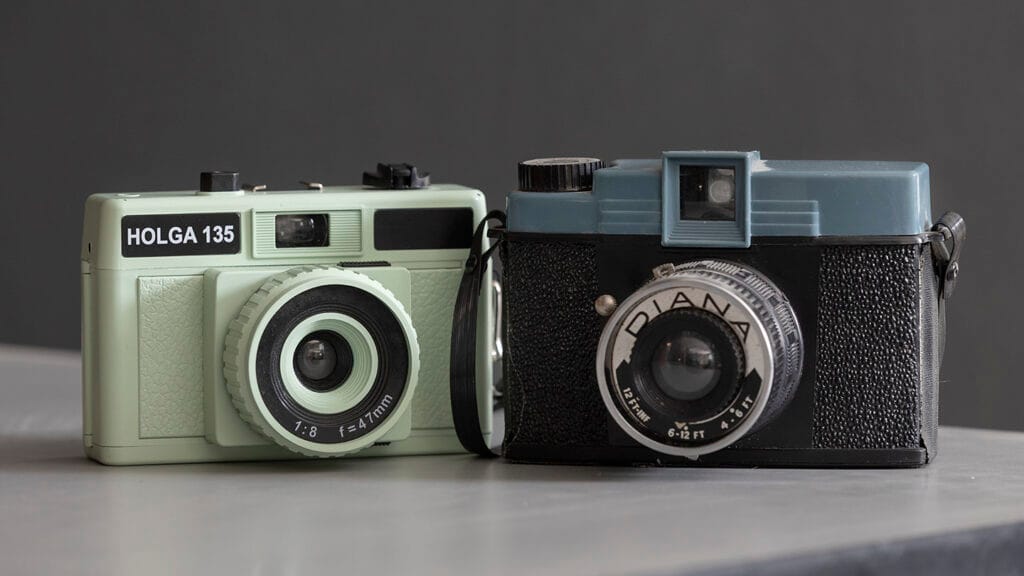
This guide uses U.S.-market camera names throughout and concentrates on interchangeable-lens, full-frame 35mm cameras. All expose a roughly 24 × 36mm image on 135 film. Medium-format cameras, including Holga and Diana models, offer another experience, but they are outside this comparison.
My first camera was a Yashica handed down to me by my dad. I don’t remember the model, but I used it throughout my beginning photography classes. The first camera I purchased was a Nikon F4—a rugged autofocus film camera that felt practically bulletproof. I especially loved the manual-focus feel of the 80–200mm f/2.8 push-pull zoom lens.
The key to success with film is do not rely on your in camera light meter. Get a hand held light meter and learn how to use it.
The short answer: choose a system, then choose a body
| Your priority | Camera to consider | First lens | Main tradeoff |
|---|---|---|---|
| Versatile mechanical SLR | Nikon FM2n | Nikkor 50mm f/1.8 AI or AI-S | Costs more than many basic SLRs |
| Affordable mechanical system | Minolta SR-T 101 or 201 | MC/MD 50mm f/1.7 | Heavy; older meter battery requirements |
| Mechanical Canon with FD lenses | Canon FTb / FTb-N | FD 50mm f/1.8 | Heavy; meter battery needs attention |
| Simple exposure learning | Pentax K1000 | SMC Pentax-M 50mm f/1.7 | Popularity can inflate its price |
| Compact mechanical Pentax | Pentax MX | SMC Pentax-M 50mm f/1.7 | Small controls; check meter and shutter |
| Compact travel SLR | Olympus OM-1 / OM-1n | OM Zuiko 50mm f/1.8 | Meter battery and prism condition |
| Premium manual rangefinder | Leica M6 Classic | M-mount 35mm or 50mm | Expensive; limited close focusing |
| Convenient autofocus film shooting | Nikon F100 or Canon EOS Elan II | Compatible 50mm autofocus prime | Battery-dependent; more electronics |
These are practical recommendations, not a laboratory ranking of every camera ever produced. Condition can reverse the order: an excellent Canon FTb is a better purchase than a malfunctioning Nikon FM2n.
What does “manual film camera” actually mean?
Three separate characteristics often get mixed together.
Manual exposure means you choose the aperture and shutter speed. A camera can offer manual exposure while using electronics to time the shutter.
Manual focus means you turn the focusing ring yourself. Many manual-focus cameras also offer automatic exposure.
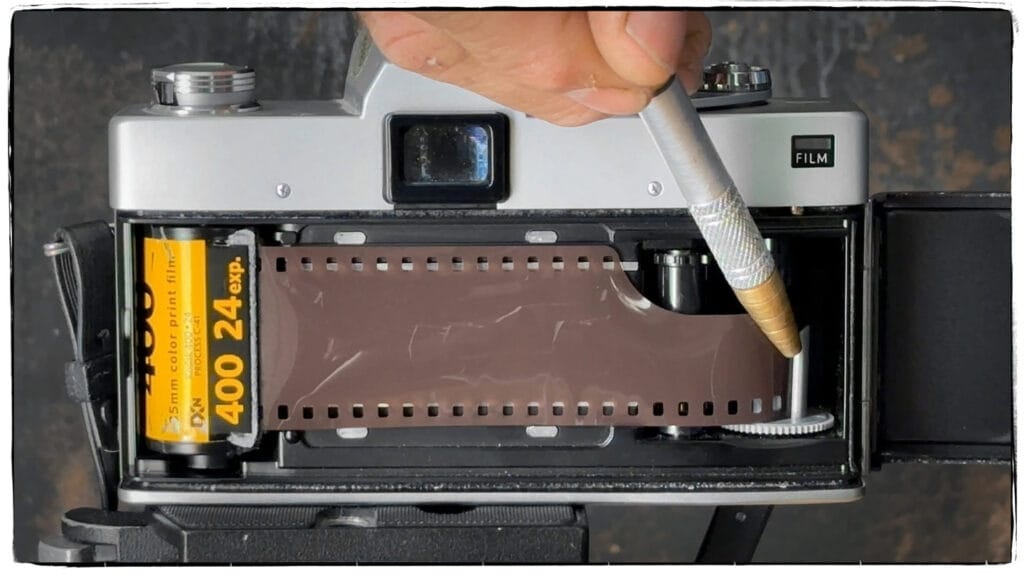
Mechanical shutter operation means the shutter can make its normal timed exposures without electrical power. In many mechanical cameras, the battery powers only the meter.
A Pentax K1000, Canon FTb, Minolta SR-T, Olympus OM-1, or Nikon FM2n combines manual focusing, manual exposure, and a mechanically timed shutter. The meter can stop working while the camera remains usable with an external meter.
By contrast, the Canon AE-1 and Minolta X-700 are manual-focus cameras with electronic shutters. They are not battery-free mechanical cameras, even when you select manual exposure. The Nikon FE2 and F3 also rely on batteries for normal operation, although they have limited mechanical backup settings. The FM3A is an unusual hybrid: mechanical timing in manual exposure and electronic timing in aperture-priority operation.
What changed with the electronic SLRs of the 1990s?
Cameras such as the Nikon N90s, Nikon F100, Canon EOS Elan II, and Canon EOS Rebel models added combinations of autofocus, motorized film transport, sophisticated metering, and automatic exposure modes. Many also allow full manual exposure and manual focusing.
Their advantage is speed and convenience. A photographer can concentrate on timing, changing subjects, or composition while the camera handles selected tasks. Their disadvantages include battery dependence, aging electronic parts, and interfaces that can be less direct for learning exposure.
Electronic cameras are not inherently less capable of making beautiful negatives. Mechanical cameras are not indestructible. Choose mechanical operation because you enjoy it or need its particular advantages – not because electronics somehow make film less authentic.
Why the lens matters more than the badge
On digital cameras, changing the body can change the sensor. With film, the recording material moves from camera to camera in a cartridge. Put the same film behind comparable lenses, expose it equally, and process it the same way, and two sound bodies can produce very similar results.
The lens has a direct role in sharpness, flare, contrast, distortion, out-of-focus rendering, and the usable range of apertures. Film stock, development, scanning or printing, camera support, and focusing technique also strongly influence the finished image.
Still, saying the body has “no effect” goes too far. A dragging shutter can produce uneven exposure. A leaking door can fog film. A damaged pressure plate or film transport can scratch negatives or compromise film positioning. An inaccurate meter can mislead you. Misaligned focusing components can make apparently sharp subjects come out soft.
The useful principle is this: a functioning body supports the picture; the lens, film, exposure, and processing shape much of its visual character. Buy reliability first, then invest in the lens you will actually use.
Why start with a prime lens?
A prime has a fixed focal length. A 50mm f/1.7, f/1.8, or f/2 is often the most sensible first purchase: compact, relatively bright, and affordable. Its focusing ring and aperture markings are easy to use, and one consistent angle of view helps you learn to anticipate framing.
A fast prime also gives you choices. Open the aperture for low light or selective focus; stop down when you need more depth of field. However, a lens is not automatically at its sharpest wide open. Many vintage lenses improve noticeably when stopped down a little.
Two 50mm lenses may offer the same angle of view, but they can produce noticeably different image quality. Much of that difference comes from the optical glass, lens design, coatings, and manufacturing precision. A better lens can capture finer detail and maintain sharpness more consistently across the negative—from the center to the corners.
Lens quality also affects how clearly subtle differences in tone and texture are recorded. Good optics and effective coatings reduce flare and scattered light, helping preserve contrast and keep shadow detail from looking washed out. This can produce richer, more clearly defined images, although highlight and shadow detail also depend on the film, exposure, and development.
Primes are not always optically superior to every zoom. Their appeal here is the combination of simplicity, size, speed, and value. An old zoom that came free in a kit may be useful, but evaluate its condition and performance before building your photography around it.
A useful three-lens kit
For 35mm film, 28mm + 50mm + 100mm or 135mm covers a great deal. The 28mm works for interiors and environmental pictures; the 50mm handles general photography; the longer lens provides working distance and tighter framing. A 35mm can replace the 28mm if you prefer a less expansive view.
An 85mm or 100mm makes a comfortable portrait option. A 135mm is often less expensive, but requires more space and steadier technique. Perspective changes when you change camera position; the focal length changes the angle of view and influences where you stand to achieve a particular framing.
Nikon: an excellent mechanical system
First choice: Nikon FM2n
This image is of the FM2 not the FM2n
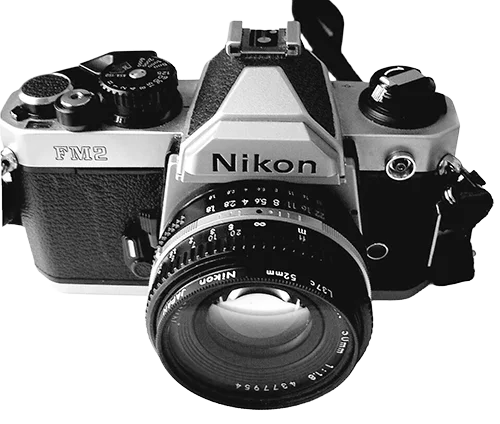
The FM2n is a strong recommendation for photographers who want a compact mechanical SLR with room to grow. Its 1/4000-second top speed helps when using faster film or wider apertures outdoors. Its 1/250-second flash synchronization is useful for balancing flash with daylight. The earlier FM2 synchronizes at 1/200 second; check the actual version. Nikon was more sought after by pros at the time.
Pros: direct controls, mechanical shutter, useful shutter-speed range, and a broad supply of compatible manual-focus lenses.
Cons: higher purchase prices than many basic models, manual exposure only, and age-related wear that a famous name cannot prevent.
Estimated used body budget: $300-650. As a concrete market reference, MPB’s U.S. FM2n page showed six bodies at $444-634 when checked September 25, 2026. That is a dealer snapshot, not a promise of future availability.
The earlier Nikon FM, roughly $150-300 as a planning allowance, is worth considering if you do not need the FM2n’s highest speeds. The F2, roughly $250-600 depending heavily on finder and condition, offers a larger professional system with interchangeable finders. Verify which finder is included and whether its meter works. The original Nikon F is historically important, but age, finder condition, and service requirements make it a more deliberate first purchase.
Nikon lens picks
| Lens | Estimated used budget | Pros | Cons |
|---|---|---|---|
| Nikkor 50mm f/1.8 AI / AI-S | $80-180 | Compact, bright, useful everyday focal length | Versions differ in construction and close-focus distance |
| Nikkor 28mm f/2.8 AI-S | $180-350 | Useful wide angle; close focusing makes it versatile | Costs more than simpler 28mm options; confirm AI-S version |
| Nikkor 105mm f/2.5 AI / AI-S | $150-300 | Comfortable portrait working distance and subject isolation | Longer lens demands more care with focus and shutter speed |
Nikon deserves credit for the longevity of the F-mount, but the same mount does not guarantee compatibility. Unmodified non-AI lenses can damage the indexing mechanism on an FM2/FM2n and many later bodies. Choose an explicitly compatible AI or AI-S lens for this kit. AF and AF-D lenses with aperture rings can be useful on many older bodies, but check the exact combination. G lenses lack aperture rings, and newer E-type electronic diaphragms introduce other limitations.
Nikkor lenses include many excellent designs. That does not establish that Nikon lenses universally outperform Canon, Minolta, Pentax, or Olympus. Compare specific lenses and individual condition, not brand mythology.
Canon: excellent FD lenses and a choice of camera styles
Mechanical choice: Canon FTb / FTb-N
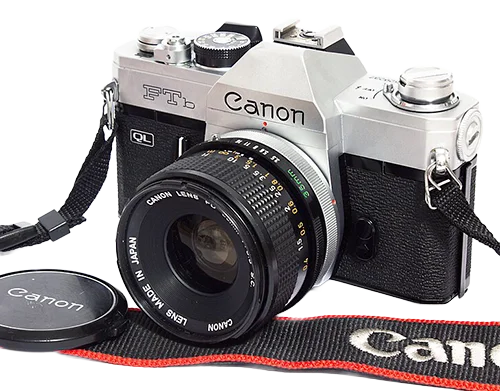
The FTb is a compelling alternative to a Nikon mechanical body. It offers manual exposure, a mechanically timed shutter, Canon’s Quick Load system, and selective central metering. The later FTb-N adds refinements including a shutter-speed display in the viewfinder. Its lens mount accepts FD lenses; FL lenses require a different metering workflow.
Pros: straightforward operation, solid construction, useful metering, and access to a large manual-focus lens system.
Cons: substantial weight, a meter designed around an obsolete mercury cell, and the usual need to inspect shutter timing and foam seals.
Estimated used body budget: $80-200. A serviced example may cost more. Ask whether the meter has been converted or calibrated for a particular modern battery solution. A physically fitting 1.5V cell is not automatically an accurate electrical substitute.
The AE-1, approximately $120-250 body-only, is a popular electronic alternative with shutter-priority automatic exposure and manual control. The AE-1 Program, approximately $150-300, adds program exposure. Both require a battery to operate normally. If a seller describes an AE-1 as “fully mechanical,” the description is wrong. An unusual squeal or hesitant cycle deserves professional evaluation.
Canon lens picks
| Lens | Estimated used budget | Pros | Cons |
|---|---|---|---|
| Canon FD 50mm f/1.8 | $40-90 | Affordable, compact, excellent first focal length | Slower than f/1.4; condition varies widely |
| Canon FD 28mm f/2.8 | $70-150 | Practical wide angle without extreme perspective demands | Wide-open corners may be less crisp than the center |
| Canon FD 135mm f/3.5 | $40-100 | Affordable telephoto for details and outdoor portraits | Needs space; slower maximum aperture |
For a faster normal lens, budget roughly $80-180 for an FD 50mm f/1.4. Buy for its extra light and rendering, rather than assuming the larger aperture guarantees better photographs.
Canon introduced EOS with the EF mount in 1987. FD lenses do not mount directly on EOS bodies. An adapter is not a simple universal solution: many lose infinity focus without corrective optics. Conversely, EF, EF-S, RF, and FD are not interchangeable labels. Choose FD for the FTb/AE-1 family and a compatible full-frame EF lens for an EOS film SLR.
Minolta: a rewarding place to look for value
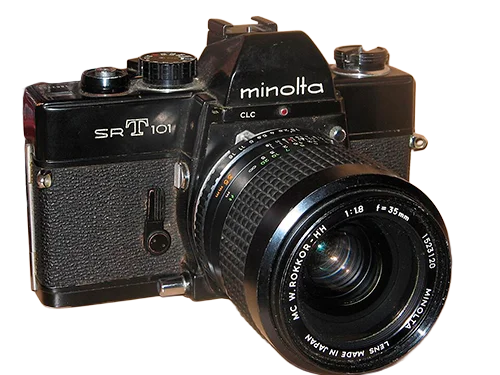
Mechanical choice: Minolta SR-T 101 / 201
A Minolta SR-T paired with a good Rokkor lens can be an excellent way to enter film photography. The controls are direct, the shutter is mechanical, and the system includes many useful primes. The SR-T 101’s two-cell CLC meter was designed to improve exposure measurement, but it still needs a photographer’s judgment in difficult light.
Pros: substantial construction, satisfying manual handling, and an appealing range of relatively accessible lenses.
Cons: considerable weight, aging meters, obsolete mercury-cell requirements on these models, and variation in features across the SR-T family.
Estimated used body budget: $60-160. A checked body-and-normal-lens combination may offer better value than buying the pieces separately, but evaluate both parts.
The Minolta X-700, roughly $100-220 body-only, is an electronic alternative with program, aperture-priority, and manual exposure. It requires battery power, and aging capacitors are a known repair consideration. Ask what was tested and whether any service has been performed. For its intended program operation, use the appropriate MD lens and follow the manual’s aperture-setting instructions.
Minolta lens picks
| Lens | Estimated used budget | Pros | Cons |
|---|---|---|---|
| Minolta MC/MD 50mm f/1.7 | $35-90 | Bright, compact and economical | Optical and mechanical versions vary |
| Minolta MD 28mm f/2.8 | $50-120 | Useful environmental and travel lens | Check the exact version and corner performance |
| Minolta MC/MD 135mm f/2.8 | $50-130 | Affordable reach and a reasonably bright aperture | Larger kit; handheld blur becomes easier |
Minolta’s manual-focus SR mount is often described in used listings as “MC” or “MD.” The later autofocus Maxxum A-mount is a different system. An AF 50mm f/1.7 and an MD 50mm f/1.7 are not interchangeable just because the name and aperture resemble one another.
Pentax: simplicity, with an overlooked compact alternative
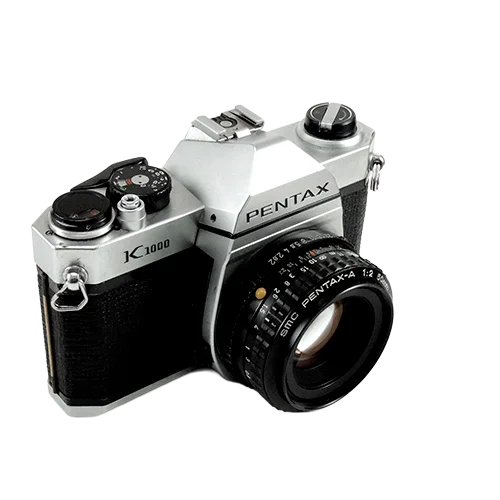
K1000 for basic operation; MX for a smaller kit
The K1000 earned its place in photography classes because its operation is easy to understand. You focus, set shutter speed and aperture, and use a straightforward meter. Its mechanical shutter works without the meter battery.
Pros: simple controls, an accessible K-mount lens system, and a clear connection between exposure settings and the result.
Cons: a limited feature set, a relatively modest flash sync speed, and demand that can make it more expensive than comparable cameras.
Estimated used body budget: $100-220. The Pentax MX, around $150-300, is smaller and adds features such as depth-of-field preview and a self-timer. Its compactness makes it attractive for travel, although small controls will not suit every hand. Consider a KM or KX too if a well-serviced example is available.
Is the K1000 the best camera for skate photography?
It can certainly photograph skating, but it is not uniquely suited to the job. However, its durability made it a favorite of skate photographers. Prefocusing at a landing point, anticipating the peak of action, and choosing an appropriate shutter speed matter more than the body’s reputation. Zone focusing is an option, not a requirement imposed by manual focus.
For flash-balanced action, the FM2n’s 1/250-second sync offers an advantage over the K1000’s 1/60-second sync. A short flash duration can freeze a subject, but ambient light can still record blur. No vintage camera should be bought on the promise that it can be dropped onto concrete and keep working.
Pentax lens picks
| Lens | Estimated used budget | Pros | Cons |
|---|---|---|---|
| SMC Pentax-M 50mm f/1.7 | $40-90 | Compact, bright, sensible first lens | Check aperture action and focusing feel |
| SMC Pentax-M 28mm f/2.8 | $60-130 | Small, useful wide angle | Not an ultra-wide; may be limiting in tight interiors |
| SMC Pentax-M 135mm f/3.5 | $40-90 | Compact and affordable reach | Slower than f/2.8; needs steadier technique |
Choose K-mount lenses with usable aperture rings for these manual bodies. Older M42 screw-mount Takumars need the correct adapter and a different workflow. Modern lenses without aperture rings are not a sensible default purchase for a K1000 or MX.
Olympus: a small mechanical SLR worth including
First choice: Olympus OM-1 / OM-1n
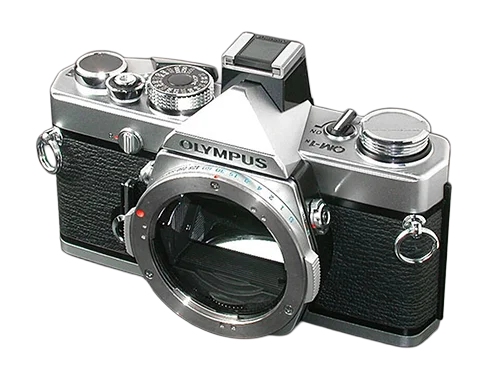
The OM-1 demonstrates that a manual SLR does not have to feel enormous. Paired with a small Zuiko prime, it makes a pleasing travel or everyday camera. Its shutter-speed ring sits around the lens mount, an arrangement some photographers love and others need time to learn.
Pros: compact body, compact lenses, mechanical operation, and an uncluttered shooting experience.
Cons: an obsolete meter battery specification, possible prism deterioration in neglected examples, and an unfamiliar control layout for some users.
Estimated used body budget: $130-280. Ask about the meter’s battery solution and whether deteriorated internal foam or prism damage has been addressed. The OM-2 is an electronic, automatic-exposure alternative; it should not be confused with the mechanical OM-1.
Olympus lens picks
| Lens | Estimated used budget | Pros | Cons |
|---|---|---|---|
| OM Zuiko 50mm f/1.8 | $40-90 | Small, bright and easy to carry | Versions and coating condition vary |
| OM Zuiko 28mm f/2.8 | $90-180 | Compact wide angle for travel | Often costs more than slower alternatives |
| OM Zuiko 100mm f/2.8 | $140-280 | Compact portrait option with useful working distance | Less common than a normal lens; condition premium |
Look for the original Olympus OM film mount. Modern OM System lenses use a different mount; the digital OM-1 and the original film OM-1 share a name, not a lens interface.
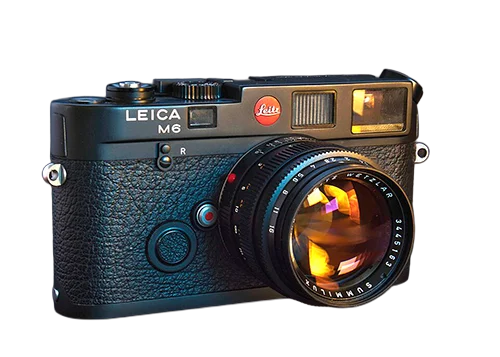
Leica M: a premium choice for a particular way of seeing
First choice to investigate: Leica M6 Classic
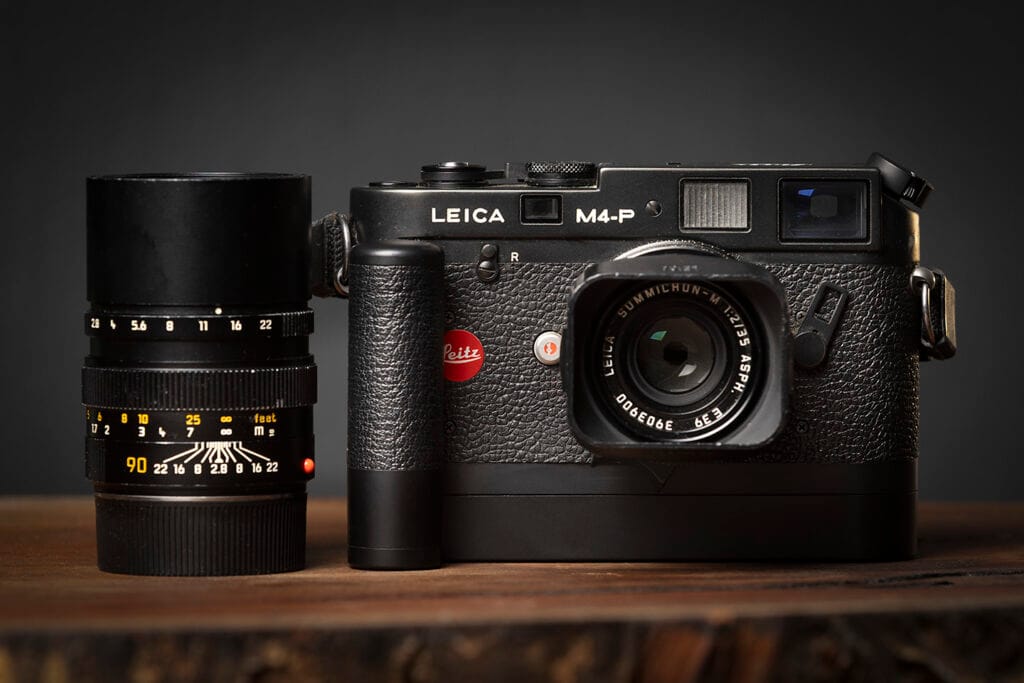
A Leica M is a rangefinder, not an SLR. You compose through a separate optical finder and align a focusing patch. There is no reflex mirror, and the finder can show space around the selected frame lines. That experience can be appealing for street and documentary work.
An M6 Classic combines a mechanical shutter with a battery-powered meter. The M6 TTL and the reintroduced 2022 M6 are different versions; specify which one you are comparing. Do not confuse a film M6 with a digital M camera.f
Pros: superior compact rangefinder lenses, a distinct viewing experience, quiet operation, and a mature system.
Cons: high purchase and service costs, rangefinder alignment requirements, approximate framing at close distances, and limited close-focus or long-lens practicality compared with an SLR.
Estimated used M6 Classic body budget: $2,000-3,500. Finder version, finish, service history, and collectibility can move prices beyond that range. Other M bodies deserve research: M2/M3/M4 variants usually lack a built-in meter, the MP is a premium mechanical option, and the M7 is electronically timed in normal operation.
Leica M-mount lens picks
| Lens | Estimated used budget | Pros | Cons |
|---|---|---|---|
| Leica Summicron-M 50mm f/2, common pre-ASPH versions | $900-1,800 | Compact standard lens; established service ecosystem | Expensive; version and condition matter greatly |
| 35mm f/2 Summicron ASPH | $2,400-$2,600 | Razor-sharp edge-to-edge clarity. High contrast with minimal distorion | Peripheral softness and high price |
| Zeiss Planar T* 50mm f/2 ZM | $450-750 | Strong alternative to a Leica-branded normal lens | Still a substantial investment; check mechanical condition |
You do not have to buy a Leica-branded lens to use a Leica M body. Verify mount, rangefinder coupling, frame-line behavior, and minimum coupled focusing distance. A fast lens is unforgiving of a misaligned rangefinder.
Leica makes outstanding equipment, but claims of universally “peerless” optics or guaranteed investment value are not useful buying advice. Different designs render differently, and a costly lens will not compensate for poor focus, flare, or an underexposed negative. Try the rangefinder experience before paying for it.
Exposure matters – especially when you want usable shadow detail
Accurate exposure helps every film. With conventional black-and-white negative film, underexposure is particularly damaging to the shadow information you hoped to retain. A thin negative may scan into something recognizable, but editing cannot fully recover detail that was never recorded.
A reflected-light meter interprets whatever you point it at as a middle tone. A bright sky can make the foreground too dark; a dark subject can lead the meter to give more exposure than you intended. Decide which tones matter instead of treating the centered meter needle as an automatic guarantee.
For a deliberate shadow placement, meter an important textured dark area closely enough to isolate it, then give approximately two stops less exposure than that reading to place it around Zone III. For example, if that isolated shadow meters at 1/125 second and f/4, using 1/125 at f/8 places it two stops below middle gray. This is a measured placement method, not a rule to underexpose every scene.
The familiar phrase “expose for the shadows, develop for the highlights” describes a useful negative-film principle. Exposure establishes shadow detail; development strongly influences contrast and highlight density. With roll film, one development treatment affects every frame, so you cannot independently tailor development to each scene.
Start at the film’s box speed, use a consistent development method or lab, and examine the negatives as well as the scans. If results are consistently thin, investigate metering, shutter timing, film speed, and processing before deciding that the film needs a different rating. Slide film is generally less forgiving than black-and-white negative film, particularly of excess highlight exposure. [9]
Many classic shutter dials use full-stop settings; some aperture rings have half-stop clicks or allow intermediate settings. Follow the manual before setting a shutter dial between marked speeds. The absence of third-stop clicks does not prevent accurate exposure.
Where to buy a used film camera
KEH is an established used-equipment specialist with a broad catalog. Its condition grades and item notes help compare examples, but read exactly what is included and whether an item is being sold for normal use or as-is. A catalog page may remain online when stock is unavailable. [10]
B&H Photo Video and Adorama also maintain used departments, including film equipment when available. Independent camera stores, repair shops, and specialist film dealers can also be valuable – especially when they document service and allow a return after testing. KEH is not the only U.S. source focused on used cameras.
Compare the total package: purchase price, lens, batteries, seals, any repair allowance, shipping, tax, and return terms. “Mint” usually describes appearance. “Shutter fires” is a much narrower statement than “shutter speeds were measured and a film test passed.” Ask what a CLA – clean, lubricate, adjust – actually covered, who performed it, and when.
What to inspect before buying a body
1. Smell and storage condition. A musty odor is a warning of damp storage. Look for corrosion, residue, swelling, or deteriorated coverings. Odor alone cannot tell you the internal condition.
2. Battery compartment. Check for leakage, damaged contacts, missing covers, and the correct battery specification. Old mercury-battery meters may need a voltage-correcting adapter, suitable zinc-air replacement, or professional recalibration.
3. Shutter curtains or blades. With no film loaded, inspect for tears, pinholes, wrinkles, damage, or contamination. Never touch the shutter. Fire several speeds and check that slow speeds behave plausibly; listening cannot verify accurate fast speeds or reveal every capping problem.
4. Film transport. Check winding, frame counter, rewind release, back latch, spool, sprockets, pressure plate, and film rails. Do not force a jammed advance lever.
5. Seals and mirror bumper. Crumbling or sticky foam often needs replacement. Repairable foam is a bargaining point, not proof the rest of the camera is healthy.
6. Viewfinder and focusing. Inspect for haze, fungus, dark prism patches, and damaged focusing aids. A rangefinder patch should be visible and align appropriately; near-distance accuracy needs testing too.
7. Meter. Compare against a trusted meter or camera using the same ISO and a uniform subject across more than one light level. Two meters viewing different areas can disagree without either being broken.
8. Test roll and return window. Photograph evenly lit surfaces at several speeds, focus at near and distant subjects, and inspect for uneven exposure, leaks, scratches, spacing problems, and missed focus. Process the roll while a return is still possible.
What to inspect before buying a lens
Look through the lens from both ends. A small amount of internal dust is common and usually inconsequential. Do not reject every vintage lens because a flashlight reveals a few particles. Haze, branching fungus, element separation, severe scratches, or coating damage are more meaningful concerns.
Turn the focusing ring through its range. It should move smoothly without grinding, loose play, or extreme stiffness. Examine the mount, filter threads, aperture ring, and any coupling levers for damage. Ask whether the lens has been dropped or dismantled.
On an automatic-diaphragm SLR lens, the blades should stop down promptly and reopen correctly when operated as the manual specifies. Sticky blades or oil on these mechanisms can cause exposure errors. Do not assume a detached Canon FD lens is broken because its interlocks prevent normal aperture behavior off-camera; test it mounted correctly. On manually operated rangefinder lenses, traces of oil have different practical implications, but sluggish motion or damaged blades still requires evaluation.
Finally, test photographs matter. A clean-looking lens can have decentered elements or focus problems. Check a reasonably flat subject with the camera aligned carefully, then make real pictures at the distances and apertures you expect to use.
How much should you spend?
The figures in this guide are broad U.S.-dollar planning estimates prepared September 25, 2026, not appraisals, quoted offers, or verified market averages for every item. Body ranges exclude lenses; lens ranges exclude bodies. Normal working examples are assumed. Tax, shipping, repairs, rare variants, and collector premiums are excluded.
Current dealer inventory was checked where accessible. Several listings did not expose a price or were out of stock, so those ranges remain editorial budgeting allowances. Ask for current prices and compare equivalent versions and condition. A documented overhaul or meaningful warranty can justify paying above a private-sale range.
A sensible first kit is one tested body, one clean 50mm lens, a strap, the correct battery or metering solution, and enough budget to shoot and process several rolls. Reserve money for service rather than spending the entire budget on the body. Add a second focal length when your photographs show you what is missing.
My practical recommendation
For a durable, flexible mechanical 35mm system, start your search with a Nikon FM2n and compatible 50mm AI/AI-S lens. If cost matters more, investigate a Minolta SR-T with a 50mm f/1.7 or a Canon FTb with an FD 50mm. A Pentax MX or Olympus OM-1 is attractive when compactness matters; a K1000 remains a clear, uncomplicated learning tool when priced sensibly.
Choose a Leica M because you prefer the rangefinder experience and can comfortably afford the complete system. Choose a later electronic SLR if autofocus and convenient exposure modes help you make the photographs you want.
Whatever you choose, learn it well. When exposure and focusing become second nature, more of your attention is available for composition, gesture, light, color, and timing. That is where a useful camera becomes a meaningful photographic tool.
Honorable Mentions: Other Film Cameras Worth Considering
The cameras featured above are excellent starting points, but they are not the only worthwhile options. Several less-discussed models offer appealing combinations of handling, lens selection, and exposure control. Some are fully mechanical, while others combine manual focusing with electronic shutters and automatic exposure.
Nikkormat FT3: A Solid Alternative to the Nikon FM
The Nikkormat FT3 deserves consideration if you enjoy substantial metal cameras and straightforward controls. It incorporates Nikon’s AI lens-metering system and uses an SR44 silver-oxide battery for its meter, avoiding the original mercury-battery requirement of some earlier Nikkormats. Its mechanical shutter remains usable without meter power.
Its main drawbacks are weight and a shutter-speed ring positioned around the lens mount, which may take some adjustment. Pair it with a compatible Nikkor 50mm f/2 AI or 50mm f/1.8 AI for a practical everyday kit.
Best for: Photographers who prioritize sturdy construction and direct operation over compactness.
Canon F-1: A Professional Mechanical Workhorse
The original Canon F-1, including its revised 1976 version, is worth investigating if you like the FD system but want a more extensive professional camera platform. Interchangeable finders and focusing screens distinguish it from simpler models such as the FTb. A Canon FD 50mm f/1.4 makes a useful starting lens.
The tradeoffs are size, weight, and the possibility of extensive professional use. Check the meter, finder, shutter, and service history carefully. Also distinguish the original F-1 from the New F-1 introduced in 1981, which uses a different, hybrid shutter system.
Best for: Photographers who enjoy a substantial professional SLR and want to build a Canon FD system.
Honeywell Pentax Spotmatic: A Classic Route into Takumar Lenses
The Honeywell Pentax Spotmatic is an appealing option for photographers who appreciate traditional mechanical cameras. Honeywell branding appears on many U.S.-market examples. Its M42 screw mount opens the door to Takumar lenses, including a compact Super-Takumar 55mm f/1.8.
The original Spotmatic uses stop-down metering: you close the lens aperture to the selected setting while taking a meter reading. This adds a step compared with the full-aperture metering of many later cameras. Despite its name, the production Spotmatic is not a spot-metering camera.
Inspect the lens for haze, fungus, and sluggish aperture operation, and verify the camera’s meter and battery arrangement.
Best for: Photographers who enjoy a deliberate workflow and want to explore vintage Takumar lenses.
Yashica FX-3 Super 2000: A Straightforward Mechanical Alternative
The Yashica FX-3 Super 2000 combines manual exposure, a mechanically timed shutter, and a relatively lightweight body. Its top shutter speed of 1/2000 second adds flexibility in bright light. The battery powers the meter rather than the shutter.
Its Contax/Yashica mount accepts appropriate Yashica and Carl Zeiss lenses made for that system. A Yashica ML 50mm f/1.9 or f/2 is a sensible starting point. Access to Zeiss lenses is attractive, but those lenses can substantially increase the total kit cost.
The body feels less substantial than some older metal SLRs, so inspect the controls, covering, and film transport carefully.
Best for: Photographers seeking a simple mechanical camera with an interesting lens system.
Minolta X-570: An Electronic Camera with Useful Manual Control
The Minolta X-570 is worth considering alongside the better-known X-700. It offers aperture-priority automatic exposure and a useful manual-exposure display that shows the selected and recommended shutter speeds. That makes it convenient for learning exposure while retaining the option of automatic operation.
Pair it with a Minolta MD 50mm f/1.7 for a compact general-purpose kit. Its principal limitation is battery dependence: manual exposure does not turn it into a mechanically operated camera. Test the shutter, meter display, and automatic exposure before buying.
Best for: Photographers who want manual focusing and exposure control with occasional automatic-exposure assistance.
Canon A-1: More Exposure Options in the FD System
The Canon A-1 expands on the appeal of the AE-1 by offering aperture-priority, shutter-priority, and program automatic exposure, along with manual control. Its electronically controlled shutter requires battery power.
A Canon FD 50mm f/1.8 or f/1.4 provides a useful starting point. The main tradeoff is a more involved control system: read the manual and practice changing modes before loading an important roll. Check that the camera operates correctly across its exposure settings.
Best for: Photographers who want several exposure options while staying with manual-focus Canon FD lenses.
Nikon FM3A: Mechanical Operation with Aperture-Priority Convenience
The Nikon FM3A is an especially appealing upgrade for photographers who like the FM2n but also want aperture-priority exposure. Its hybrid shutter provides mechanically timed manual speeds and electronically controlled aperture-priority operation. The meter and automatic exposure require batteries, but the manual shutter speeds remain available without them.
A compatible Nikkor 50mm f/1.8 AI-S makes a compact companion. The FM3A’s additional capabilities are useful, but they do not improve the negative automatically. Compare its purchase cost with a serviced FM2n and consider whether you will regularly use automatic exposure.
Best for: Photographers who want traditional mechanical control and aperture-priority convenience in one body.
A well-maintained example of any of these cameras can be a rewarding photographic tool. Give condition, lens compatibility, service history, and handling more weight than popularity—and leave enough room in your budget to use the camera regularly.
Sources and further reading
1. Nikon: FM2 instruction manual, FM2 history, and FM3A history. For exact lens exclusions and operation, use the manual for your body.
2. Canon Camera Museum: FTb and FTb-N.
3. Canon Camera Museum: AE-1 Program, A-1, and historical overview.
4. Original Minolta instruction manuals, preserved by Butkus Camera Manuals, including SR-T 101. Select the exact model manual.
5. Original Pentax manuals: K1000 and manual-focus Pentax archive.
6. Original Olympus OM-1 instruction manual archive.
7. Leica: M6 instructions and M6 downloads. Current M6 literature describes the reintroduced version; check vintage documentation for a specific Classic or TTL body.
8. MPB Nikon FM2n U.S. inventory, checked September 25, 2026. Used prices and availability change.
9. ILFORD: technical downloads and film FAQs. Consult film-specific data for exposure and processing.
10. Dealer resources: KEH film cameras, B&H used equipment, and Adorama used film cameras.